Learn how community development organizations help create places of opportunity where ALL people live with dignity while participating in and benefiting from our Commonwealth's economy.
MACDC advocates on behalf of our members and the communities they serve to create the public and private sector policies that will promote community development throughout Massachusetts.
MACDC’s programs and services are designed to support our members in specific areas of community development and to strengthen the effectiveness of the broader community development system.
The Community Investment Tax Credit provides a 50% state refundable tax credit for donations to selected Community Development Corporations in Massachusetts.
MACDC provides a variety of online resources from job listings at member organizations to community development reports and research. This information is updated frequently.
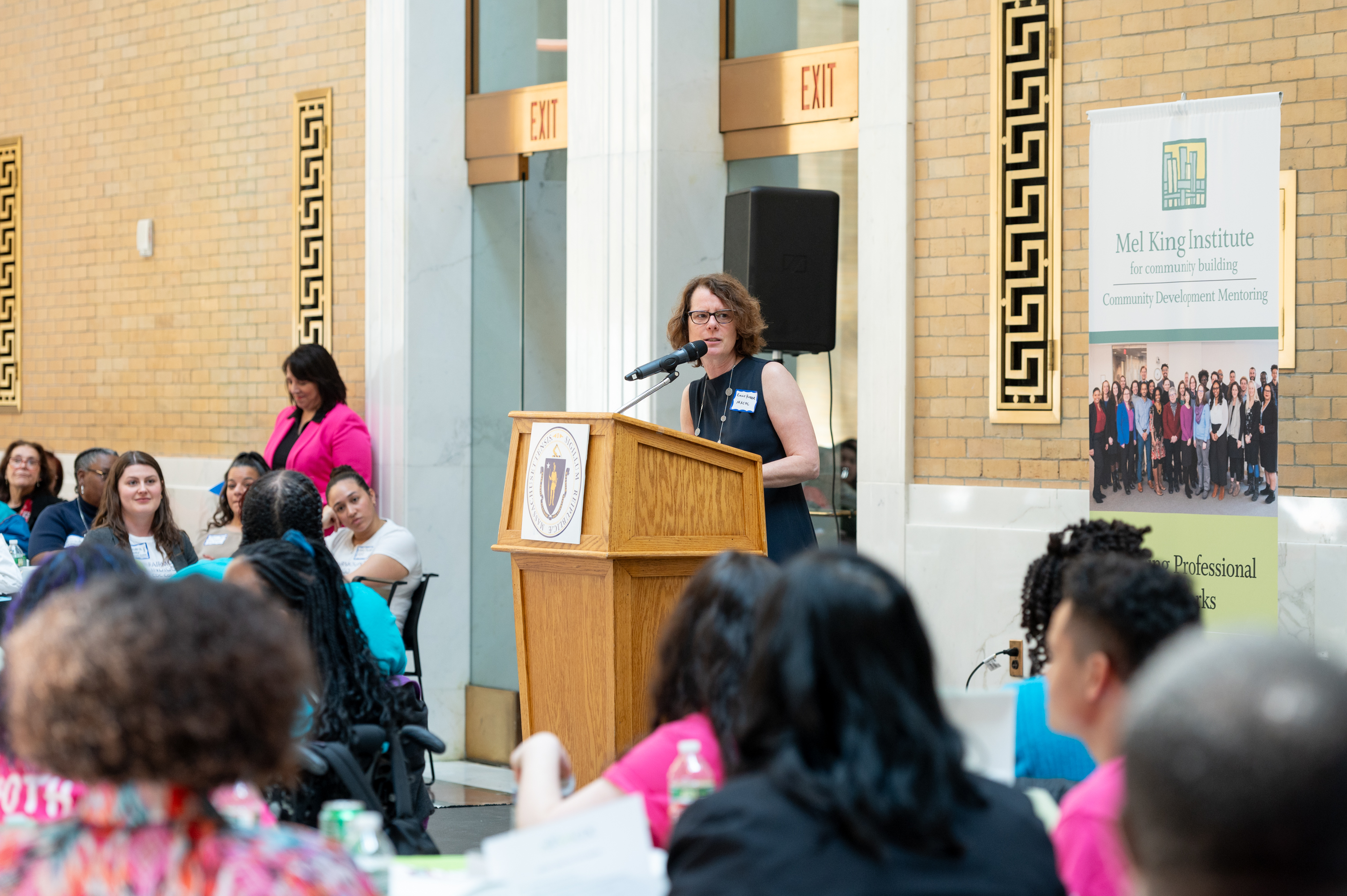
On Friday, November 20th at Clark University in Worcester, MA, over 200 leaders and staff members from CDCs and community development organizations came together to discuss the latest developments in our field, hear from Jay Ash, State Secretary for Housing and Economic Development and, of course, network! A special thanks to Bank of America and all our sponsors. Check out the agenda for the day, as well as information on the breakout sessions.
A special congratuations to the recipients of this year's MACDC Community Development Awards:
The Jeffrey Graham Award: Clark University
The Richard Smith Award: Jeanne Pinado
The Ricanne Hadrian Award: Katie Provencher
The Rise Star Award:
Andrea Aldana, Community Develoment Partnership
Charlise Canales, Worcester Common Ground
Rachana Crowley, Valley CDC
Jason Desrosier, Allston-Brighton CDC
Lisette Le, Viet-AID
A special thanks to Ryan Rios, who photographed the event and whose photo is used with this article.
On Monday, November 16th, United Way of Massachusetts Bay and Merrimack Valley, MACDC and Boston LISC were joined by Governor Baker and over 120 business, philanthropic and community development leaders to learn more about the Community Investment Tax Credit. MACDC's President Joe Kriesberg had an opportunity to speak - here are his remarks:
Good morning and thank you for coming.
I’m Joseph Kriesberg, President of the Massachusetts Association of CDCs. We serve as the policy and capacity building arm of the community development field and played a key role in enacting the Community Investment Tax Credit.
I also serve on the Local Advisory Board of the Local Initiatives Support Corporation which works to build stronger neighborhoods by investing in CDCs and community based economic development initiatives. Bob Van Meter, the LISC Director, is here with us this morning as well.
We are thrilled to join with our partners at the United Way to co-host this breakfast.
The CITC is rooted in three core values that serve as the foundation of the community development field.
The first is that people should have agency over their own future – both the future of their community and the direction of their own lives. And we believe that this can best be achieved when we come together as a community to get things done.
The second is that everyone should have the opportunity to participate in the economic mainstream and achieve their own full potential, regardless of where they live, where they came from or their racial or ethnic background.
The third core value that we work to advance is “inclusion”. We believe that our communities and our Commonwealth need to include everyone regardless of race, ethnicity, gender, or background --and we believe that we must work to reverse the historic and systemic bias that persists in our society.
For more than forty years, CDCs have put those values into action.
In your packets, you have a copy of our GOALs Report – Growing Opportunities, Assets and Leaders, this is MACDC’s Annual State of the Sector Report. You can see what our members achieved last year. And, if you think those numbers are impressive, listen to what they have achieved over the past ten years:
Spurred over $3 billion of investment in our communities.
Created or reserved over 12,500 homes
Created or preserved over 28,000 job opportunities
Helped 15,000 entrepreneurs start, stabilize or grow their own business
Served nearly 400,000 families
These numbers are visible all across the state. You can walk just a few blocks from here to Chinatown and see One Greenway preparing to welcome over 200 new residents to a mixed-income, mixed use development – indeed the ribbon cutting is tomorrow. Or take a walk to the South End and visit Villa Victoria one of the oldest CDC housing developments with over 400 families living in high quality apartments. As you travel further to Roxbury, Dorchester and Jamaica Plain you will see more housing, community & cultural centers, commercial buildings, a Food incubator, a factory, and small business complex and more – all developed by CDCs. Along the way, you will also meet local businesses that received a loan or technical assistance from a CDC, construction workers employed on CDC projects and first time homeowners educated by the CDCs like the Allston Brighton CDC.
But it is not just Boston. Go to the Main South neighborhood in Worcester and see how the CDC partnered with Clark University to completely transform the neighborhood; go to Greenfield to visit the Franklin County Food Processing Center which serves dozens of locally owned businesses; go to Fitchburg and visit the homeowners who were able to keep their home thanks to foreclosure counseling from the NewVue CDC; go to Chelsea and meet the single mothers who are accessing job training and financial coaching services that are putting them on the track to economic stability; go to Cape Cod and talk to the fisherman who are able to maintain their family tradition thanks to a partnership between the CDC and the Hook Fisherman Association.
Success stories like these abound across the Commonwealth.
The CITC was designed specifically to support this diverse array of work. It offers flexible funding that can be deployed based on the unique assets and challenges in each community.
Each CDC works with local residents and stakeholders to submit a detailed Community Investment Plan to the Commonwealth in which they lay out their vision for community improvement. The state selects the best plans and awards them an allocation of tax credits of up to $150,000 a year.
CDCs then use those tax credits to attract new donors and to enable existing donors to give more. Each dollar of state revenue is matched by a dollar of private revenue, creating a stable and diverse revenue stream for these high impact organizations. In fact, the 50% refundable state tax credit, combined with federal tax benefits, means that some individuals can get nearly 80 percent of their donation back.
Donors can be individuals, corporations, small businesses, foundations, universities, hospitals, and donor advised funds. Even those with little to no tax liability can benefit by getting a refund.
The CITC also gives donors three choices about how and where to invest.
Donors can give directly to one or more of the 47 CDCs participating in the program – there is a list of these groups in your packet.
Donors can give to MACDC or LISC – the two Community Support Organizations designated by DHCD to provide training, technical assistance and capacity building services to CDCs.
And, of course, donors can give to the United Way’s Community Partnership Fund which distributes the funding to CDCs across the state.
Last year, this program attracted over 1,000 donors and $4.7 million. This year, with your help, it is poised to double in size.
Together, Governor Baker, the United Way, LISC, the local CDCs, everyone in this room and many others not here today - are building momentum to transform communities and change lives.
Thank you so much for getting involved and for helping us to spread the word.
I'm now honored to introduce Susan Esper, Board Chair of UW and Partner at Deloitte, one of the largest supporters of the program.
In preparation for the 2015 general elections and 2016 presidential and congressional elections, ACDC received funding from the Coulter Foundation to increase voter registration and voter education in the Asian American and Pacific Islander (AAPI) community. We worked with South Cove Community Health Center, Quincy Asian Resources Inc., Boston Chinatown Neighborhood Center, the Chinese Progressive Association, and the Patriot Ledger to sponsor a Quincy candidates forum for mayoral and city councilor-at-large candidates. The forum had simultaneous Mandarin and Cantonese translation to encourage attendance by the Asian community, which comprise over 25% of Quincy’s population. Education, infrastructure, affordable housing and supporting the significant immigrant and Asian population were some of the topics addressed by the candidates. More than 200 community members attended.
In addition to the candidates’ forum, we also organized a Get-Out-The Vote phonebanking campaign with Quincy Asian Resources Inc. and Boston Chinatown Neighborhood Center. Our staff and volunteers made a combined 3,116 phone calls targeting registered Asian voters in Quincy.
The election also resulted in the first Asian American City Councillor in Quincy!
On Wednesday, October 28th, Senator Linda Dorcena Forry and Senator Sal DiDomenico were joined by Undersecretary for the Department of Housing and Community Development, Chrystal Kornegay, at a legislative briefing on the Community Investment Tax Credit, hosted by the United Way of Massachusetts Bay and Merrimack Valley. Along with numerous legislative representatives, the audience was comprised of CDC leaders and staff. The speaking agenda was engaging, especially with strong testimonials concerning the impact of the program by Carol Ridge Martinez, who highlighted how the CITC program is strengthening her organization, Allston Brighton CDC, and Karen Frederick, who emphasized how Community Teamwork is hiring new staff thanks to this new initiative. As the Community Investment Tax Credit continues to attract new donors, CDCs across the Commonwealth are able to increasingly provide new services and work toward lasting mission success.
Urban Revival BlaQ Ink'D is a new program presented by 4 Elements and sponsored by Worcester Common Ground with a mission to capture our city's youth through creativity and self-expression using urban art. During a 3 month session, our mentoring artist Mark Thomas has instructed youth on the enriched culture of hip hop, street art, and artistic skills. Using public art as a vessel for social justice this group of youth plan to revitalize abandoned buildings and empty spaces through miniature murals. They hope to feature their works in local art galleries and live art performances. These displays will provide an opportunity to build up their personal art portfolios, breathe life back into the community and break down negative perceptions that have kept them historically isolated.
To learn more about Urban Revival BlaQ Ink'D, check out their Facebook page.
On November 3rd, Joe Kriesberg, MACDC's President, was recognized by CHAPA with a Community Service Award for his incredible accomplishments successfully advocating for critical resources to further support and drive increased community economic development across the Commonwealth. While the recognition by CHAPA is quite an honor, the comments LISC Boston Executive Director, Bob Van Meter, spoke to the genuine passion and character of Joe and how he has dedicated his professional career to advocating for issues and causes for which he deeply cares. Bob's comments are below:---Thank you. It is my pleasure and honor to present the next award.Joe Kriesberg has provided leadership at the state and national level for the community development field and all those concerned about low- and moderate-income neighborhoods for more than twenty years.Joe has served as President and CEO of the Massachusetts Association of Community Development Corporations for over thirteen years. I was board chair of MACDC in 2002 when we made the decision to hire Joe as President. I count that as the best hiring decision I ever made. It was in fact, a no brainer, as Joe had served very ably on the staff of MACDC since 1993.As President of MACDC, he has worked to increase the power and voice of CDCs and the communities where they work. Joe initiated biannual MACDC conventions bringing together hundreds of leaders from all over the state. These have now become a required stop for candidates for the Commonwealth’s corner office.He has led a renewal of the community development movement in Massachusetts by winning passage of a new enabling statue for CDCs and an updated state certification process that has focused on comprehensive approaches to neighborhood development.Joe led the way in founding the Mel King Institute for Community Building, which has proved an important and durable vehicle for building the capacity of CDC staff and leaders and allies.Joe has led on housing issues, serving as co-chair of Mayor Walsh’s transition team on housing and helping to win increases in housing resources at the city level.At a time when there was a void in national advocacy, Joe led the way in creating a new national voice for community development as a founding board member of the National Alliance of Community Economic Development Associations (NACEDA). Joe has been a leader of NACEDA since its inception and speaks regularly to NACEDA member associations around the country.Though Joe never served as a CDC executive director or a project manager, he has demonstrated time and again the qualities that all of you know are key to success in community and affordable housing development, grit and persistence.His work to win passage of the Community Investment Tax Credit showed all of that. Joe stayed focused on the goal and made it his job to insure that Governor Patrick and the legislature did too. For a period of weeks when Governor Patrick’s support for the legislation was uncertain, Joe made sure that at every ground breaking or ribbon cutting where Governor Patrick appeared, he would be there and that the Governor’s office would be deluged with calls from community development leaders. In the last days of this saga, Joe and the rest of the MACDC staff were on their annual summer outing, a walking tour of the African American Freedom trail on Beacon Hill, when they encountered Governor Patrick walking his dog and Joe crossed the street to speak to the Governor. The Governor responded, “You can stop Joe. I will sign the bill.” And he did of course.MACDC won passage of the Community Investment Tax Credit and with Joe leading the way to help implement the credit, $4.7 million flowed to support CDCs across the state in the first year.I know Joe would want me to remind all of you tonight that we have the opportunity to invest $60 million in the future of our neighborhoods over the next five years using the 50% Community Investment Tax Credit, but we need all of you to join Joe in helping us make it a success.
Two military families will soon be able to put down roots in Worcester and Millbury. Recognizing the need for affordable homeownership opportunities for veterans and military families, Bank of America donated two properties to Project Homefront, an initiative spearheaded by Worcester Community Housing Resources. Project Homefront aims to provide the security and stability of homeownership to families who have served their country.
With their expertise in affordable housing development and rehab, WCHR fully renovated the two homes, transforming them into quality, family-sized housing. They worked with MassHousing to arrange mortgages for eligible buyers. WCHR will sell the homes to eligible families at affordable prices. Buyers will pay 60 percent of the sale price, and WCHR will cover the rest of the cost with a forgivable lien.
For Bank of America, the decision to work with a CDC like Worcester Community Housing Resources came down to shared values. “We share Worcester Community Housing’s commitment to honoring those who’ve served, and their track record of improving the community in meaningful ways made them an ideal partner for the home donations,” said Ed Shea, Bank of America Worcester market president.
This project gives military families the opportunity for homeownership and the stability that comes with putting down roots. After the sacrifices that these families have made in service to the Commonwealth and our country, they deserve nothing less than a place to call home.
MACDC applauds the Baker-Polito Administration’s new Real Estate Leveraging (REAL) Strategy that will use the public’s real estate assets to achieve important public policy goals, in particular the creation of new affordable housing and economic development opportunities.
Last year, candidate Charlie Baker spoke at the MACDC Convention about leveraging the state’s real estate assets to create more housing. Now, Governor Baker is turning that pledge into reality.
We are particularly pleased to see that this proposal emphasizes housing production generally and affordable housing specifically. This will require a creative, flexible and entrepreneurial approach – precisely what Governor Baker presents with this program. This approach requires balancing the need to generate revenue with the need to provide land at a price that allows the creation of affordable housing, without using limited public housing subsidies to pay for public land.
MACDC also supports the focus on creating economic development opportunities outside of Greater Boston where housing costs are less expensive, but economic growth has been slower.
MACDC and its members stand ready to partner with the Baker-Polito Administration to transform these under-used public assets into homes and jobs across the Commonwealth.
On September 29th, Urban Edge welcomed Frank Shea as their new Executive Director. Prior to joining Urban Edge, Frank was the Executive Director of the Olneyville Housing Corporation in Rhode Island for fifteen years. During this time, Frank grew the organization from two staff to fourteen with an annual operating budget over $1.5 million.
On September 15th MACDC joined with partners from the Massachusetts Smart Growth Alliance, MAPC and CHAPA and testified before the Joint Committee on Community Development and Small Business in support of legislation to update the Commonwealth’s zoning laws. S.122, An Act Promoting the Planning and Development of Sustainable Communities is co-sponsored by Senator Dan Wolf, Rep. Sarah Peake, and Rep. Steve Kulik who noted “Our zoning laws are widely known to be as antiquated and as out of touch with the modern world as any you’ll find anywhere in the country.”
S.122 will encourage new jobs and more housing, offering new models and resources for community planning and additional safeguards for public health and natural resource protection. Massachusetts and, in particular, the Greater Boston region will undergo dramatic changes in population over the next 25 years. More than a million workers will retire during this time, and we will need to attract younger workers from other places to sustain and grow our economy. With this shift in demographics and housing needs, the Metropolitan Area Planning Council (MAPC) and other experts suggest we need to build 500,000 new housing units between 2010 and 2040; 87 percent of that projected housing need is in Greater Boston, approximately two-thirds of which should be multifamily housing.
The bill presents a balanced, well-crafted approach that offers greater certainty and predictability for developers and property owners, enhanced protections for important natural and agricultural landscapes, and an enhanced set of tools and incentives for local officials and citizens to guide and shape the future of their communities. MACDC members have a long track record of balancing these three goal. CDCs work collaboratively with local residents and local governments to identify community goals and develop projects with strong local support. Over the years, our members have developed more than 17,000 apartments and hundreds of homeownership units as well as dozens of commercial buildings and green spaces. CDCs will benefit from the additional and expanded definitions and authorizations for many useful zoning techniques, including cluster development, inclusionary zoning, and variance provisions that will facilitate more community-scale residential projects as well as a consolidated permitting process that will benefit larger, more complex projects.