


News

February 2026 MKI and Leadership Development Updates

February 18th, 2026 by Molly Marshall

Featured Professional Development workshops: 

Featured Community Leadership Academy workshops: 


Learn more about our upcoming workshops and events here! 


For CDC Board Members: 

Introduction to Community Economic Development for CDC Boards 

This workshop is an exploration of contemporary community development and aims to provide CDC Board Members with an understanding of the work and equipping them with the knowledge and skills needed to navigate the complexities of this field and drive positive change within communities. 


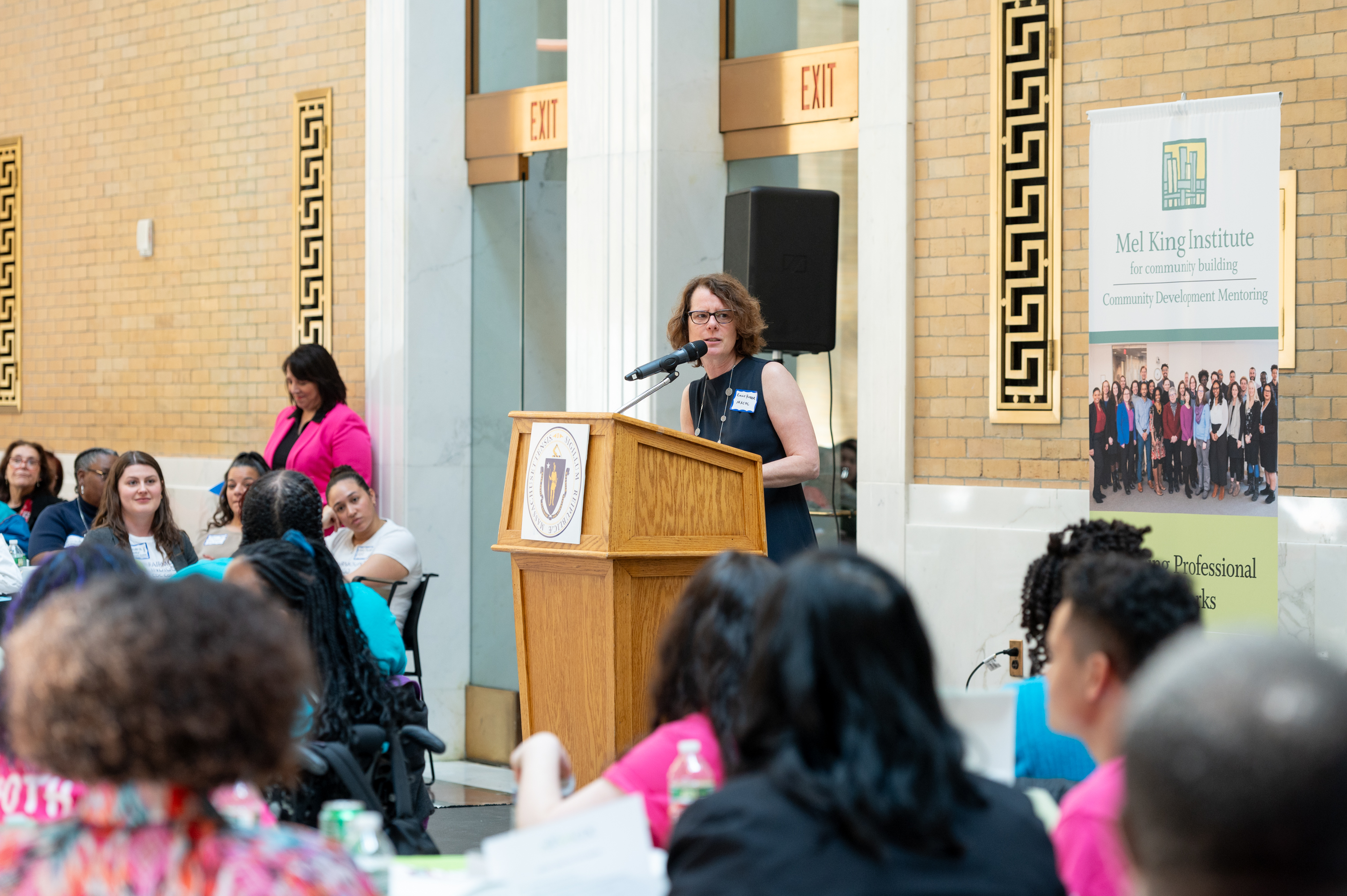
In this session, Mel King Institute Director Shirronda Almeida will cover: 

  • History: First we will define community development and delve into the origins of the field.   

  • Ecosystem and Key Players: Learn the community development landscape and the roles of different entities.   

  • Core Values and Goals: The session will review the fundamental principles that guide community development work.  

  • Types of Community Economic Development: We will review the areas of community development such as real estate development, community engagement, small business, capacity building and advocacy.   

  • Challenges, Opportunities, and Innovations: We will invite participants to discuss the various challenges and opportunities in the field. 

Free registration and available to all Board of Directors of MACDC member and associate member organizations 


Effective Board Structures and Meetings 
March 16, 4 pm - 6 pm 

Board members must understand their roles, as well as the functions and benefits of different board structures and procedures. Well run board meetings are essential to avoid delays in decision making and to support organizational effectiveness. This workshop provides board members with practical tools to lead and participate in focused discussions, ensure meetings end with clear responsibilities and shared understanding, and embed equity principles in both board structure and day to day operations. 

Participants will learn how to prepare for meetings, present information clearly, develop effective agendas, use consent agendas and dashboards, support strong meeting facilitation, and contribute to a productive and equitable board culture. The workshop is led by Viana Nascimento, Leadership Development Program Manager at MACDC’s Mel King Institute, who brings extensive experience as a nonprofit board member, facilitator, and equity practitioner. 

Free registration and available to all Board of Directors of MACDC member and associate member organizations. 


Introduction to Affordable Housing Finance for CDC Boards 
April 6, 12-2 pm 

This two-hour workshop gives board members a clear introduction to how affordable housing is financed in Massachusetts, with a focus on the key decisions and responsibilities that matter most for nonprofit developers. The goal is to help board members feel more confident and prepared to engage in discussions about their organizations’ development projects. 

Laurie Gould from VIVA Consulting will explain the major funding sources for affordable housing, including mortgage debt, federal and state Low Income Housing Tax Credits, and state and local soft financing. We will also review how organizations cover their costs and generate revenue during both development and operations. The session will walk through the typical cash flow timeline and highlight the risks at each stage: predevelopment, construction, lease up, and operations. We will also discuss sponsor responsibilities related to financing, including predevelopment spending, guarantees, and long-term asset management. 

Available to all CDC Board Members. Registration fee: $25 for one, $20 if registering 5 or more people at a time 


Introduction to Affordable Housing Development for CDC Boards 
May 4, 12-2 pm 

This two-hour workshop is intended for board members who want an overview of the issues that boards typically address when their organizations develop affordable housing. These issues include creating your organization’s vision for these projects: who do you want to serve, where, and with what types of housing, and understanding the roles and responsibilities of boards, including their fiduciary responsibilities and how these differ from those of staff. 

In this webinar, Louise Elving will address the variety of rewards organizations may pursue beyond creating the housing itself, such as financial return to your organization. Conversely, what risks may you encounter, from financial exposure to opportunity cost? In addition, the webinar will give you an overview of the wide range of public requirements involved in affordable housing development, identifying some key issues you may need to consider as board members (for example, balancing wealth-building and long-term affordability in homeownership projects). 

Available to all CDC Board Members. Registration fee: $25 for one, $20 if registering 5 or more people at a time. 


MACDC’s Organizer’s Peer GroupMarch 26, 3:30-5 pm 

We are relaunching the Organizer’s Peer Group! The first meeting will be on Thursday, March 26, from 3:30 to 5:00 pm. Individuals across the broad range of experience and background engaged in all forms of community organizing and outreach across our CDC network are welcome to join! 

This group will be a space for peer-to-peer learning, where participants can share resources, brainstorm solutions, ask for support with challenges, and collectively identify topics and guest speakers for future sessions. Everyone will have the opportunity to contribute as both a learner and a resource to others. 

The meeting will be facilitated by Viana Nascimento, MACDC’s Leadership Development Manager, and co-chairs Bonnie Bastien, Somerville Community Corporation’s Manager of Community Building and Organizing, and Andrea Grimaldi, Jamaica Plain NDC’s Director of Community Organizing. This peer group is for MACDC members only.

SIGN UP HERE to join our mailing list and receive details on participating in the meeting, accessing the discussion board, and other updates! 
Commenting Closed

February 2026 Housing and Real Estate Updates

February 18th, 2026 by Don Bianchi


MACDC Launches Year 2 of Its Acquisition Strategies Initiative: 

On February 9th, MACDC convened a joint meeting of its Housing Peer Group and Acquisition Strategies Initiative (ASI) working group. MACDC’s ASI work in 2025 culminated in the publishing of its Report“Here Today, Here Tomorrow: CDC Acquisition of Naturally Occurring Affordable Housing,” as well as in a in a webinar hosted by The Boston Foundation. 


In 2026, we will dig deeper into two of the Report’s findings: 

  • When buildings become subject to acquisition, the presence of organized tenants can serve as a meaningful deterrent to speculative investors. 

  • CDCs and other mission-driven organizations have greater opportunities for successful acquisition when they learn of the potential for acquisition before the property is broadly marketed. 


At our February 9th meeting, we heard from several CDC practitioners about how tenant and community organizing provided the CDCs the opportunity to acquire NOAH properties. They also discussed how the relationships they established in the communities they serve provided awareness of available NOAH properties before they were widely advertised on the market. 


MACDC’s ASI work is ongoing. If you have questions about it, review the Report, and reach out to Don Bianchi, MACDC’s Director of Housing, at donb@macdc.org if you have questions about it. 


Governor Announces Affordable Housing Awards in Pittsfield 


At an event in downtown Pittsfield on February 17th, Governor Healey and Lt. Governor Driscoll announced almost $140 million in affordable housing awards, along with $8.4 million from the new Commercial Conversion Tax Credit Initiative (CCTCI) to help communities transform empty or rundown commercial buildings into new homes. 


MACDC’s Director of Housing, Don Bianchi, attended the event, as did representatives of several MACDC Member organizations which received awards. EOHLC Secretary Augustus highlighted the dozen communities which received awards. Projects sponsored by five MACDC Member organizations received awards: 


  • Turtle Woods in Beverly, sponsored by Harborlight Homes, is the preservation and rehabilitation of an occupied senior housing development, which will provide 67 affordable homes, with supportive services, for seniors. 


  • Asian CDC, working with The Community Builders, will newly construct Parcel P-12C, consisting of 111 affordable apartments in a high-rise in Boston’s Chinatown neighborhood. 


  • In Boston’s Fenway neighborhood, Fenway Forward will newly construct 112 Queensberry Street, consisting of 24 affordable homes for families, and will provide resident services and programs. 


  • Rural Development, Inc. will include adaptive reuse and new construction of 32 affordable homes in Greenfield, for its 176 Main Street project. 


  • Linden Street Apartments in Pittsfield will include new construction and adaptive reuse into 35 affordable apartments, developed by Hearthway, in partnership with Causeway Development. 


In her remarks, Lt. Governor Driscoll talked about the collective efforts to create a culture that is “housing forward.” 


Commenting Closed

February 2026 Public Policy Update

February 18th, 2026 by
  • Updates from Nathanael Shea, Director of Public Policy

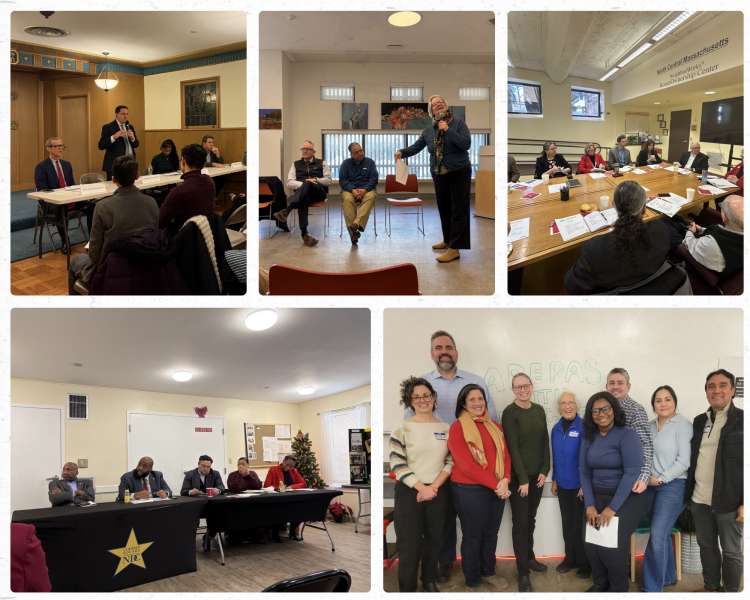
  • Photos from Donuts with Your Delegates: Fenway Forward (top left), Southwest Boston CDC (top middle), NewVue Communities (top right), Codman Square Neighborhood Development Corporation (bottom left), and Somerville Community Corporation (bottom right). 

  •  

  • Donuts with Your Delegation! 

  • Over the past few weeks, CDCs across the state have held dozens of meetings with their legislative delegationsYou’ve advocated for crucial state funding for programs like RAFT, SBTA, Ch. 206 Homebuyer Counseling, and so much more. You’ve made sure they’re prioritizing the policies that will ensure we can build vibrant communities. And you’ve shown them that CDCs have our sleeves rolled up and are doing the work of making our communities affordable, safe, and healthy places where all can thrive. Congratulations to everyone who held a meeting for taking this crucial advocacy step!

  •  

  • MACDC Lobby Day – April 15th! 

  • Don’t forget to Save the Date for MACDC’s State House Lobby Day on April 15th! Registration details and other information will be coming out very soon. 

  • Join the AHEAD Coalition to Fund Affordable Housing and Climate Resilience 

  • MACDC is part of the AHEAD Coalition, which is advancing legislation to raise revenue for investments in affordable housing and the fight against climate change. Our coalition is growing, and you can add your voice to it! Please email MACDC’s Director of Public Policy, Nathanael Shea, at nshea@macdc.org if you wish to be added to the growing list of supporters! And if your org is already on the list but you haven’t been receiving the coalition emails, please let Nathanael know so he can update your org’s primary contact! 


Commenting Closed

February 2026 Health Equity Updates

February 18th, 2026 by Elana Brochin

In December, we had meetings with leaders in each of our Housing Quality and Health Equity Initiative’s second cohort of Gateway Cities. Leaders in Lynn, New Bedford, and Worcester met to further refine goals for how MACDC can support local housing quality and health work. The full groups will be meeting next in March, with working group meetings taking place in February. 

On January 14th we hosted our biannual gathering of leaders from our Housing Quality and Health Equity Initiative’s first cohort of Gateway Cities. Leaders from Brockton, Springfield, and Holyoke had the opportunity to connect within and across cities to discuss the progression of local housing quality and health work. 

MACDC’s Health Equity Committee met on February 2ndWe welcomed Denise January from the Environmental Justice Network Assistance Network (EJAN) to share about the ways that CDCs can connect to EJAN's work. Also, Joella Orozco, our new Health Equity Intern, shared about how her academic and professional background led her to MACDC. Our next meeting will be April 6th at 2pm. 

MACDC’s Director of Health Equity, Elana Brochin, attended A Critical Moment for Supportive Housingat the State House. This event  was held in order to help legislators and policymakers understand the significant impacts of potential changes to the U.S. Department of Housing and Urban Development (HUD) Continuum of Care funding implications on thousands of people currently living in permanent supportive housing across Massachusetts. Among presenters at the event was Just A Start’s Carl Nagy-Koechlin.

Commenting Closed

2024 CITC Impact Report

February 6th, 2026 by Molly Marshall

The Community Investment Tax Credit: A Report on Impact in 2024

Since its inception in 2014, the Massachusetts Community Investment Tax Credit (CITC) program has been an integral and reliable source of funding for Community Development Corporations (CDCs) across the state. In 2024, CDCs raised over $19 million to support their activities through this unique program. CITC provides an avenue of fundraising for CDCs that allows for the growth and adaptation of programs across the state in response to the most pressing needs of their communities.
 
Every year CDCs commit themselves to gathering data and reporting on the six main aspects of their work: community leader engagement; families supported; homes built or preserved; job opportunities created or preserved; small business entrepreneurs assisted; and funds invested by CDCs in local communities. This invaluable data, gathered via the GOALs survey administered by MACDC, provides a unique window on the multiple ways in which CDCs respond to the needs of their constituents.
 
In 2024, CDCs across Massachusetts:
• Engaged 1,583 community leaders
• Created or preserved 1,095 homes
• Created or preserved 4,563 job opportunities
• Provided technical or financial assistance to 2,005 entrepreneurs
• Assisted 82,689 families with housing, jobs, or other services
• Invested more than $1.36 billion in the communities they serve
 
CDCs also measure their impact by tracking increases in their capacity in three main areas: staff growth; program expansion; and investment in infrastructure improvements. CITC has contributed to increased CDC impact by making possible impressive growth in each of these areas.
 

Expanding Staff Capacity:

The ever-growing demand for CDC services stretches the capacity of CDC staff teams. New investments made possible by CITC have allowed many CDCs to expand staff capacity in response. In 2024, 74% of CDCs reported that they were able to expand their staffing. Because of the lack of restrictions on funding provided through CITC, CDCs are able to add staff in areas of highest need.

Expanding or Adding Programs:

CITC also allowed many CDCs to expand existing programs and, in some cases, add new programs. According to data collected for 2024, 65% of CDCs were able to either add programs to their repertoire or expand upon their existing programs in the face of growing needs in their communities.
 
Affordable Housing-Related Programs and Projects:
In 2024, 88% of CDCs either developed affordable housing, improved existing housing, or helped households obtain or maintain their housing, speaking to the ever-growing housing affordability crisis across the state.
Other Programs and Services:
CDCs offered a broad spectrum of other programs to residents of the communities they serve.

Improving Technological, Physical, and Human Infrastructure:

In 2024 CDC's were able to make critical improvements in their technological, physical, and human infrastructure. It is this infrastructure that allows agencies to meet the needs of their community members. Post-pandemic, the need for virtual counseling/coaching remains high, meaning that CDCs still need to be thinking about online security and related technical issues. In 2024, 39% of CDCs were able to invest in communications system upgrades to better serve their clients and community members. These upgrades have also supported the continuing professional development of their teams by allowing staff to take advantage of a wide range of training opportunities.
In addition, 31 CDCs expanded or added new community engagement activities in 2024, ranging from increased Board of Directors engagement and diversity to increased volunteerism and community outreach. When the legislation creating CITC was adopted in 2012, CDCs across the state knew that this program would open new opportunities to them and those they serve. The actual results of this unique initiative have, however, exceeded even their most optimistic expectations. As a program leveraging public and private support to address critical community needs, CITC strengthens a set of dynamic bedrock institutions whose collective mission is to ensure that all Massachusetts residents have an opportunity to thrive.
Commenting Closed
Subscribe to News